How to Choose Startup Website Development Priorities at Each Growth Stage

Content authorBy Yurii ServatkoPublished onReading time11 min read
An abstract digital interface in a futuristic space, featuring glowing geometric shapes in cool blue and purple tones against a dark background.

This article gives you a way to decide what your startup website development needs right now, based on the next business decision you have to make. It walks through priorities from prelaunch through the growth stage, then covers platform choice and the point where custom code earns its cost.

The site you need is the one that answers your next question

Most startup website development budgets get spent on the company you hope to be in three years rather than the one you're running this quarter. That's how a pre-revenue team ends up with a content management system nobody publishes to and a security section written for buyers who don't exist yet.

The alternative is a smaller site, built to answer a specific question you can't currently answer. Every stage of a company has exactly one question like that, and startup website development either produces evidence for it or it doesn't.

This guide sorts startup website development choices by the question each stage needs answered. You'll see what to build at each gate and what to defer.

Set the next gate

Before anyone opens a design tool, name the decision. It is a decision with two outcomes, such as whether to keep building this product for this segment or whether to hire a second salesperson. A gate is a decision you'll make on a date based on evidence you don't have yet.

Once the gate is named, every proposed page has to justify itself against it. A pricing page belongs on a prelaunch site only if you're testing willingness to pay. A blog belongs there only if organic search is the channel under test. If a feature doesn't produce evidence for the decision, it's a later-stage feature wearing a disguise.

The cost of skipping this step is documented. CB Insights analyzed 431 venture-backed companies that shut down since 2023 and found 43% cited poor product-market fit as a cause, well ahead of anything a better homepage would fix. Running out of capital appeared in 70% of cases, but the report treats that as the final cause of death rather than the root problem.

So the gate does double duty. It tells you what to build, and it tells you what startup website development can't do for you.

Prelaunch startup website development

At this stage you have one question: does the right person read your proposition and do something about it? Everything else is noise. The site is an instrument, and instruments get worse when you add parts.

Treat signups as a weak signal rather than proof. An email address costs the person nothing and tells you almost nothing about whether they'd pay. Paul Graham's essay on unscalable work is blunt about where the real evidence comes from: "You can't wait for users to come to you. You have to go out and get them." The site makes that outreach faster without replacing it.

Waitlist landing page design

One proposition and one primary call to action. A waitlist landing page design that offers a demo and a beta signup splits your data and teaches you nothing about either of them. Pick the action that costs the visitor the most and still feels reasonable, because commitment is what you're measuring.

Keep the form short and deliberate. Analysis of Unbounce conversion data found single-field forms converting at 13.4% against 3.6% for nine-field forms, with the steepest drop between four and seven fields. Ask for what you need to follow up and one qualifying detail that helps you sort real prospects from curious browsers.

The second job of waitlist landing page design is learning why someone raised their hand. A single open question after submission ("what are you doing about this today?") produces better segmentation than any behavioral tracking you'd bolt on at this stage.

Website analytics setup

Your website analytics setup at this point needs to show where traffic came from and what share of each source converted after they clicked the primary call to action and finished the form. That's it. Dashboards beyond this collect data that no one turns into a decision.

Privacy-conscious tooling has a practical argument behind it beyond compliance. Plausible's tracking script is 2.5KB against 135KB for Google Analytics, and because it sets no cookies you skip the consent banner and its own JavaScript weight. Lighter pages and fewer consent declines mean the numbers you're reading describe more of your actual traffic.

A useful test for any metric: write down what you'd do differently if it moved 20% in either direction. If you can't answer, remove it from the dashboard.

Let's Build Something Great

Tell us about your idea. 24-hour response. NDA-friendly.

Book a Discovery Call →

Direct feedback loops

Numbers tell you that people stopped reading. Conversations tell you why. Send a two-question email to everyone who signs up, and offer fifteen minutes to the ones who reply with something specific. Sean Ellis, who ran growth at Dropbox and LogMeIn, described the threshold he found across roughly a hundred startups: "achieving product/market fit requires at least 40% of users saying they would be 'very disappointed' without your product."

That bar is higher than it sounds. When Slack surveyed 731 users during its rapid growth period, 51% said "very disappointed", which is roughly the ceiling that strong products reach.

Compare what people say with what they do. Someone who joins a waitlist and then introduces you to a colleague is giving you evidence. Someone who calls the idea interesting and never replies again is giving you a compliment.

Early traction priorities

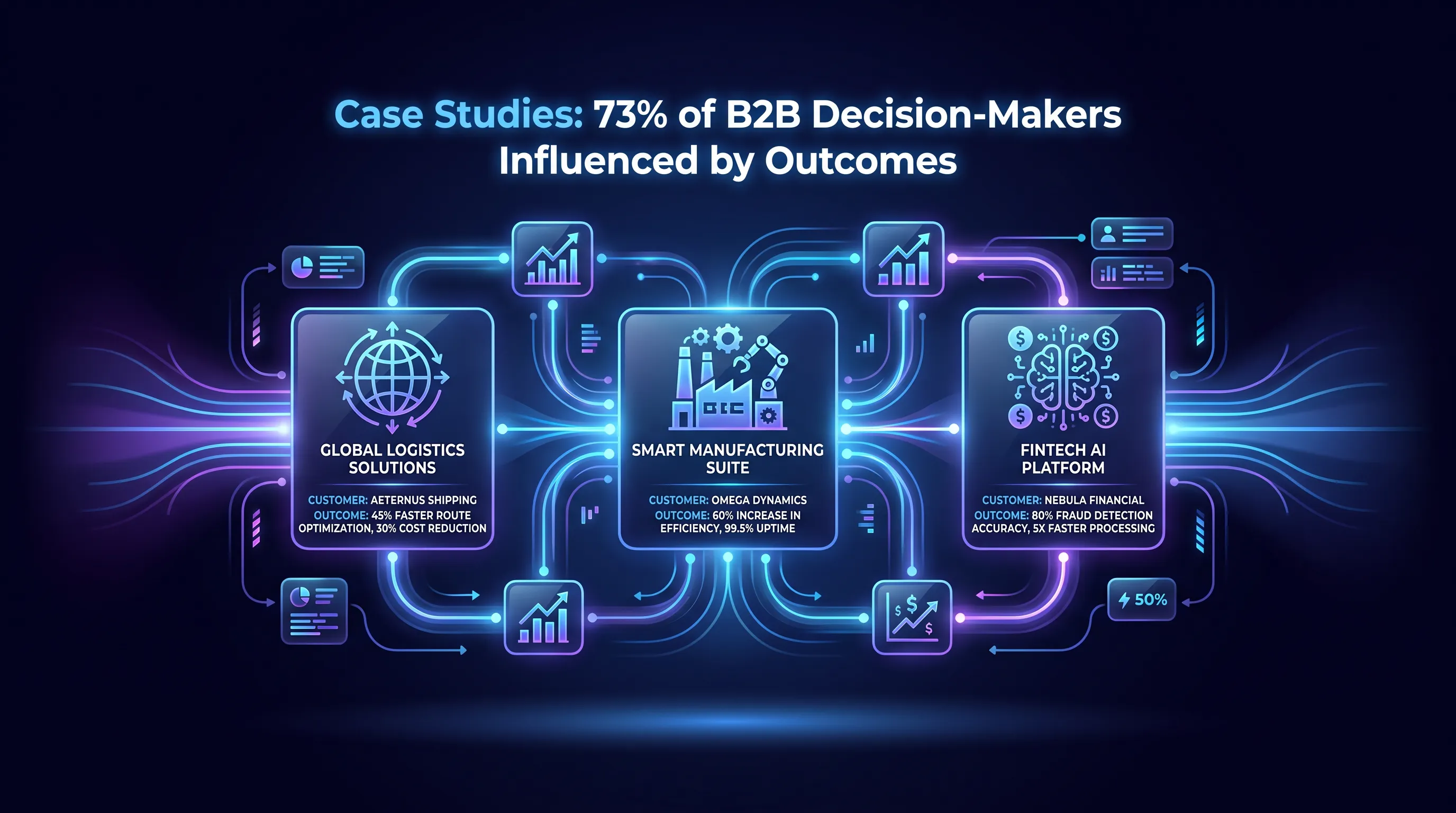
Abstract technological space with glowing interface elements illustrating case studies, featuring the text: "Case Studies: 73% of B2B Decision-Makers Influen…

The gate has moved once real usage clarifies who you're for. Now the question is whether a stranger who found you through search or a referral can understand the product well enough to start a conversation. Your message changes at this point, because customers have handed you better language than you wrote yourself.

Verified proof does the heavy lifting here. A survey of B2B decision-makers by the Content Marketing Institute found 73% saying case studies significantly influence their purchasing process, and TrustRadius reports that 56% of buyers consult existing users before purchasing, a figure that reaches 71% on enterprise deals. Named customers with a number attached beat a wall of anonymous logos.

What earns a place on the site at this stage:

  • Two or three customer stories with the outcome quantified and the customer named

  • A workflow page that shows what using the product actually looks like, screen by screen

  • Use case pages for the segments that keep closing

  • Technical search foundations: clean URLs and fast pages

Hold off on the content management system until publishing becomes a repeated operational task. If someone on the team is writing weekly and waiting on a developer to ship it, the bottleneck is real and a CMS removes it. If you've published twice this year, a CMS is overhead with a monthly bill. The same restraint applies to your website analytics setup, which now needs goal tracking tied to qualified leads rather than raw form fills.

Startup website development at this stage is mostly subtraction. You built pages for an audience you no longer target, and leaving them up dilutes the message that's working.

Let's Build Something Great

Tell us about your idea. 24-hour response. NDA-friendly.

Book a Discovery Call →

Growth stage priorities

Different buyers now arrive with different questions, and a single narrative stops serving all of them. The evaluator wants integration details. The economic buyer wants pricing logic and references. Security review sits between you and revenue.

The site has to work while you're not in the room. Gartner research found B2B buyers spend only 17% of total purchase time meeting with suppliers, and when they're comparing several vendors, any single rep gets 5% to 6%. 6sense's 2025 study puts first contact with sellers at 61% of the way through the journey, down from 69% the year before. Your pages are doing the selling during the part you can't see.

Security documentation deserves a page of its own once enterprise deals appear. A SOC 2 Type II report runs $15,000 to $50,000 in audit fees with a six-month minimum observation window, so the trust page and the compliance work need to start before the deal that requires them.

Performance stops being a hygiene issue and becomes a revenue line. The Deloitte and Google study across 37 brands and 30 million sessions found a 0.1-second mobile improvement associated with 8.4% higher retail conversions. At growth-stage traffic volumes, a regression that nobody notices for three weeks costs real money.

This is also where operational ownership gets assigned. Someone owns the content model and conversion paths into the customer relationship management system, and someone gets paged when a page breaks. Your website analytics setup should now connect form submissions to pipeline stages, because the question has shifted from "did they convert" to "did that source produce revenue."

Choose the right platform

Compare tools against the gate you're standing at. The platform question has a simple test: can the people who need to publish and change things do it without waiting for someone else?

Carrd handles one-page sites at $19 a year for ten sites with custom domains, which covers a waitlist landing page design and little beyond it. No blog, no content collections. For a prelaunch gate, that constraint is a feature, because it stops you from building pages the gate doesn't need.

Framer sits between the two, with paid site plans starting at $10 a month and a design canvas that suits teams iterating on message weekly. Webflow's Premium CMS plan costs $25 a month and gives you relational content, which matters once you're running structured content across segments. Localization is not part of that plan: it is a separate add-on starting at $9 a month. Moving between them means rebuilding by hand, since Webflow has no Framer importer.

Pick the cheapest tool that still supports the publishing and conversion work your current gate demands. Startup website development slows down when the platform outclasses the team using it.

Know when to go custom

Custom development earns its place when a measured bottleneck can't be removed any other way. Not when the platform feels limiting in the abstract, and not when an engineer on the team would rather write code than fight a visual editor.

Real migration triggers look like this:

  • Business logic the platform can't express, such as usage-based pricing calculators or gated content tied to account state

  • Integrations that need server-side processing or authenticated data from your own product

  • Workarounds that have become permanent, where each change now requires someone who knows the hack

  • Performance problems traced to platform-imposed rendering that optimization can't fix

  • Compliance or data residency requirements the vendor won't meet

Before you accept the build cost, write down what the bottleneck costs you per month in delayed launches or lost conversions. Then write down the ongoing maintenance the custom site adds: hosting and the developer time every content change now requires. If the first number doesn't clear the second, stay where you are.

The honest version of this decision is uncomfortable. Plenty of teams move to custom code and discover their marketing velocity drops, because publishing now goes through a deploy pipeline instead of an editor.

Avoid premature complexity

The Startup Genome analysis of more than 3,200 high-growth technology companies found that 74% of failures traced to premature scaling, and that roughly 70% of the companies studied scaled prematurely along at least one dimension. Startup website development is one of the easiest dimensions to overbuild, because it feels like progress and produces something you can show people.

The damage is financial, and a large site hardens assumptions. Twelve pages of positioning written before you had customers make it painful to change positioning after you do, because changing the message now means rewriting twelve pages instead of one. Learning slows down in proportion to how much you've committed to in public.

Postpone these until a gate demands them:

  • A content management system, until publishing is a recurring operational task

  • Multi-language support, until you have paying customers in a second market

  • Personalization and dynamic content, until you have enough traffic to segment meaningfully

  • Marketing automation sequences, until you know which follow-up message works manually

  • Partner and integration directories, until the partnerships are signed

None of this argues for a careless site. Your waitlist landing page design should be well written and fast, and your website analytics setup should be trustworthy. Good startup website development at an early gate means doing a small number of things properly rather than a large number adequately.

Review each gate

Praetorix Foundry works with founders at exactly these transitions. Our Website Launch engagement covers content structure and conversion-focused pages, sized to the milestone in front of you. We'll look at your customer evidence and current platform constraints, then recommend what to keep or postpone. Book a discovery call, and we'll tell you which gate your startup website development is at.

Let's Build Something Great

Tell us about your idea. 24-hour response. NDA-friendly.

Book a Discovery Call →

Review them at each decision gate, not on a fixed monthly schedule. Reassess when you receive new customer evidence, enter a market, or change the sales process. Keep the current gate visible so page requests stay tied to a decision and don't become a list of unrelated improvements.

Remove pages, claims, and calls to action built for the old audience. Keep evidence that applies to both groups, such as product capabilities or verified results. Then rewrite the homepage and highest-traffic entry pages first, because outdated language can send qualified visitors toward the wrong next step.

Yes, a static website fits a startup that publishes infrequently and has a small page set. It can reduce maintenance and hosting complexity. Choose a CMS when publishing becomes a repeated task and waiting for a developer starts delaying campaigns, customer stories, or search content.

Accessibility should be part of the first release, especially for navigation, form labels, color contrast, keyboard use, and readable text. Fixing these basics early costs less than rebuilding templates later. Test with a keyboard and an accessibility checker, then ask people with different access needs to try key tasks.

No. Custom code often slows routine edits unless it removes a measured platform bottleneck. The client should compare delayed launches or lost conversions with hosting, maintenance, and developer time. If publishing still requires a deploy for every wording change, a CMS can be the better operational choice.

Book a Discovery Call

Tell us about your idea. 24-hour response. NDA-friendly.

You Might Also Like

Discover more insights and articles