Cost to reach learning
The worksheet tracks spending. This section tracks the thing you’re actually buying, which is evidence. Eric Ries calls it validated learning in The Lean Startup: demonstrating empirically that a team has discovered valuable truths about a business’s prospects. That’s the output your decision point depends on.
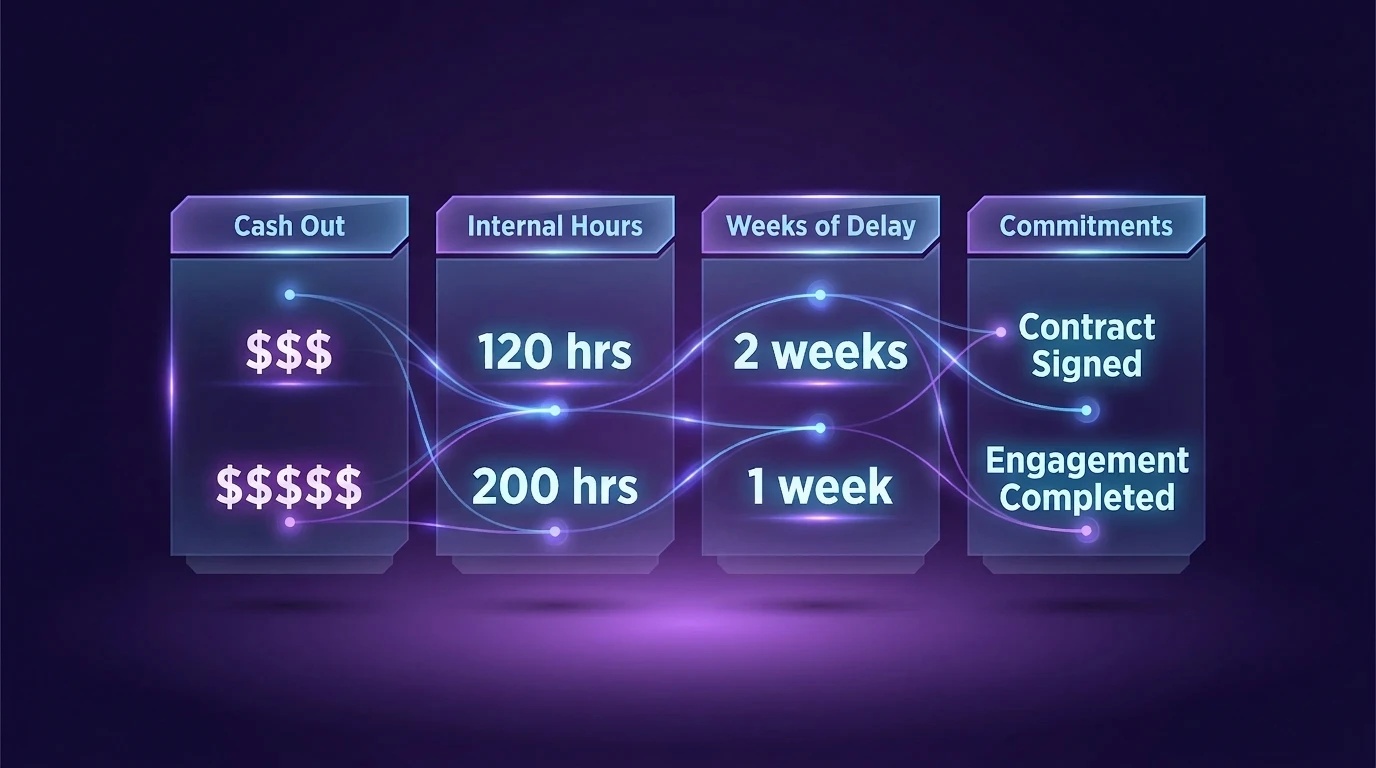
Now put the two models on the same calendar. If you are hiring every role from zero, the internal path spends its first stretch recruiting, then its next stretch onboarding people who are competent but new to your problem, and no learning begins while the requisition is open. A partner path can start discovery in week one, though it carries its own ramp-up on your domain. If your comparison treats those timelines as equivalent, it’s measuring the wrong thing. If you already have people with the right skills and context, the gap narrows or disappears.
Cheap evidence beats expensive evidence. Where the riskiest question is whether an AI feature works, Praetorix Foundry runs an AI Pilot at $9.5k-$25k for one AI use case over 2 to 4 weeks, and the firm’s own position on a failed pilot is blunt: “Then the pilot did its job, at a fraction of what a full build would have cost to learn the same thing.” CB Insights analyzed 431 VC-backed shutdowns since 2023. Among the 385 where a failure reason could be identified, poor product-market fit accounted for 43 percent, with running out of capital the final cause. Learning late is the expensive failure mode.
Ownership and rework costs
Unclear decision rights produce rework in both models, and rework is the cost line nobody forecasts. A feature gets built, and a stakeholder sees it, then the requirement changes and the team rebuilds. That churn is invisible in a salary table and invisible in a quote.
Marty Cagan, founder of Silicon Valley Product Group, argues that product teams should own the solution to a problem rather than just deliver a feature list. Read that as a split of roles: the client owns the problem and the decisions, and the delivery team, whether a partner or an in-house engineering team, needs room to propose the solution. That split has to be written into the MVP scope definition rather than discovered in week five.
There are client commitments no supplier can take over. Access to your customers and your internal data about how the work gets done today, along with a decision-maker who answers within a day and a willingness to cut scope when evidence says so. Where those commitments are weak, both models produce the same outcome of churn and duplicated work as cost factors drift every sprint upward.
Costs after launch
Launch is the start of the larger half of the spend, if the product lives. Software maintenance is commonly cited at 60 to 80 percent of total cost over the life of systems that run for years. An MVP that stops never reaches that figure, but one that proceeds will, so price the continuation before you sign the first engagement.
An internal team carries the knowledge forward and absorbs support naturally, which is the honest advantage of hiring. It also carries risk. Mercer’s survey put average U.S. voluntary turnover at 9.9 percent for white collar professionals in 2025 (13.0 percent across all industries). On a four-person MVP team, a single departure still means losing a quarter of everything nobody wrote down.
A partner engagement makes continuity a contract question instead of a retention question. The variables that matter are handover quality and documentation that someone other than the author can follow. Both paths work. Your cost factors after launch depend on which risk you'd rather manage, and the honest answer differs by company.
Model three outcomes
Run the worksheet three times, because the decision point has three possible answers and they produce different bills.
If the MVP proceeds, the internal team is already hired and ramped and ready to keep building, which is where hiring starts to repay itself. The partner path needs an extension or a continuing arrangement, and you should price that before you sign the first engagement rather than after. For ongoing work, Praetorix’s Product Partner engagement is the option to price.
If the product changes direction, the internal team carries a headcount shaped around the old plan. Retraining or reassigning people can take months, depending on how far the new direction is from their skills. If the scope you wrote at the start is still the shared reference, a partner engagement can be rescoped as a conversation instead of an argument, though change requests have a price.
If the MVP stops, the asymmetry can be sharp. Employment commitments continue past the decision as idle capacity accrues, and winding down costs real money (notice, severance). A finished engagement ends; you keep the code and the evidence, and what you owe depends on the termination terms. If you stop, that gap can be the largest variable in your model, and it only shows up if you model the stop case honestly.
Choose the delivery model
Match your situation to the closest row, then check it against your own worksheet.
| Your situation | Time to first evidence | Cash to the decision | Commitments left if it stops | Continuity after launch | What you must provide |
|---|
| Complete team available today | Fast: no hiring or ramp-up | Low new cash, but count the work the team sets aside | Low: no new commitments | Strong: knowledge stays in-house | Decide whether that displaced work is worth less than the MVP |
| Hiring every role from zero | Slower: recruiting and onboarding come first | High before any evidence, if you hire first | High: employment commitments and notice | Strong once the team is built | Budget for hiring and ramp-up, and a clear definition of launched |
| Product ownership stays with you, delivery doesn’t | Starts at discovery, plus the partner’s ramp-up on your domain | Scoped fee plus your own hours | Lower: per the termination terms you sign | Depends on handover quality and any continuation | Customer access, internal data, a product owner who decides within a day |
If your team is fully available today, build internally when the work they would put aside is worth less than the MVP. If you are hiring every role from zero, a partner can reach evidence sooner, and hiring later against proof can be cheaper than hiring now against a guess. Build internally from the start if your roadmap is long and certain, since a team you will keep for years amortizes its hiring and ramp-up cost. In the third case, Praetorix Foundry fits because the engagement is built for clients who keep the problem and the decisions while a delivery team builds. You still own the product decisions, customer access, internal data, and the scope sign-off.
Praetorix Foundry’s discovery call is free and sets the scope and price of your MVP Sprint, which includes documentation and handover. Book a discovery call, and we’ll price your MVP development cost against your actual scope.