AI App Development Cost by Product Stage and Business Model

Content authorBy Petro FominPublished onReading time12 min read
An abstract digital interface in a futuristic setting, featuring glowing geometric shapes and radiant curves against a dark background.

Most AI cost estimates fail because they are built from generic project price bands instead of what the model actually consumes. A defensible estimate starts from published provider rates and real pricing examples, then follows the feature from prototype through production, where token volumes, retries, and usage patterns change the bill. The final step converts that estimate into the unit metric the business model runs on, whether that is cost per user, per task, or per transaction, so the number can be tested against revenue rather than admired in a spreadsheet.

AI in app development

The cost of AI in app development splits into two things that behave nothing alike. One is delivery work you pay for once, like integration and security review. The other is consumption that repeats every time someone touches the feature, which means your bill tracks adoption rather than scope.

That second half is why so much budgeting goes wrong. Gartner warned that at least 30% of GenAI projects would be abandoned after proof of concept by the end of 2025, with escalating costs among the causes. Before anyone treats a number as a budget, write down the assumptions underneath it. Record request volume and average context length with retry rate and model mix, and state how much human review each output needs. An AI app development cost estimate without those five lines documented is a guess wearing a spreadsheet.

Set stage gates

Abstract digital artwork featuring stylized graphs and flowing lines in purple tones against a dark background, conveying a futuristic theme.

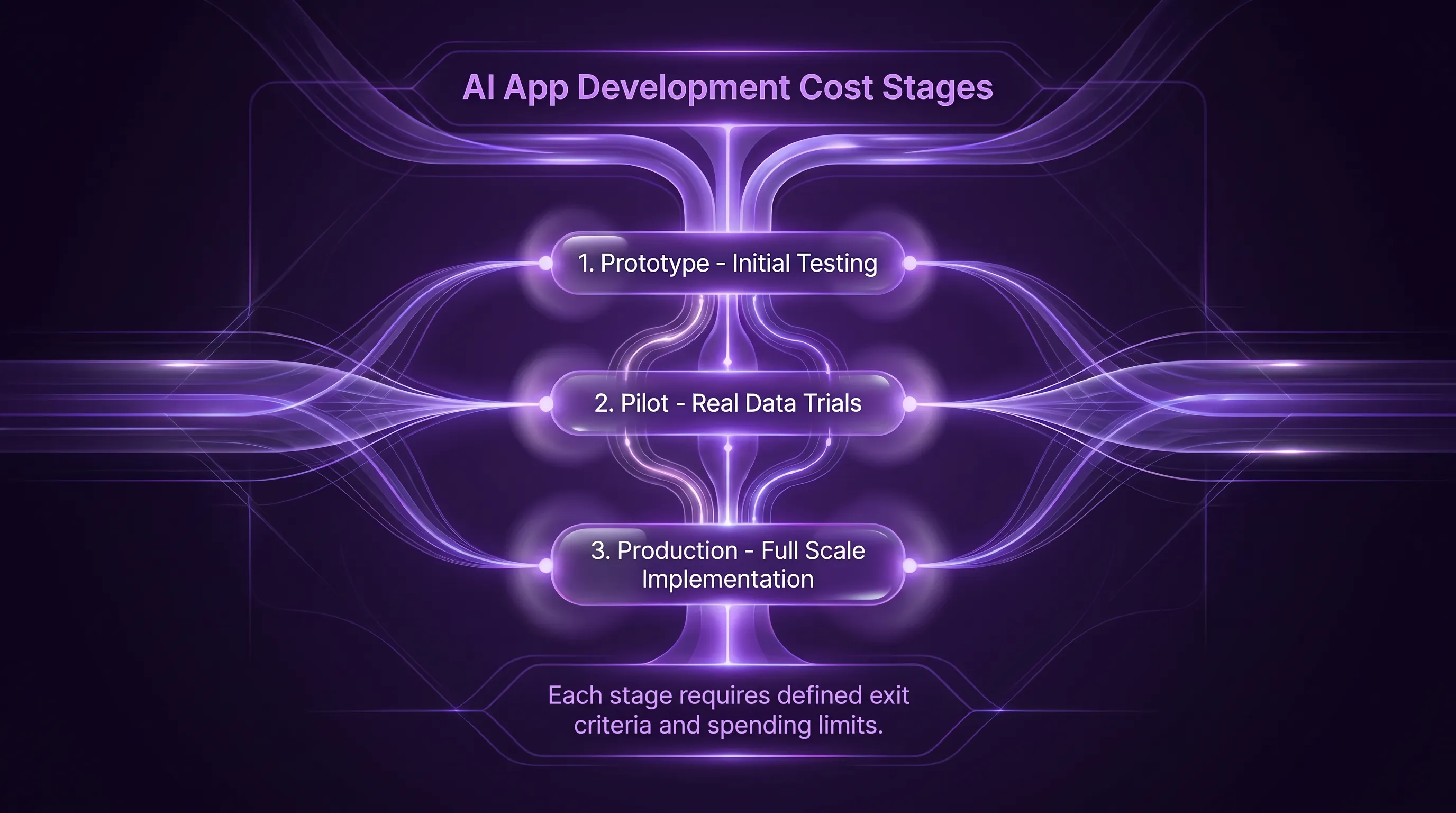
Fund uncertainty in increments. Each stage of AI in app development buys a different kind of learning, and the spending commitment should match what you still don't know. A prototype answers whether the model can do the task at all. A pilot answers whether it survives real data and real people. Production answers whether you can run it for a year without the economics collapsing.

The discipline here is refusing to extrapolate. Prototype traffic is clean and short because it is generated by people who want the demo to work, so the per-request cost you measure there understates production by a wide margin. MIT's Project NANDA found that 95% of generative AI pilots produced no measurable P&L impact, and the failures clustered around integration and workflow rather than model quality. Those are exactly the costs a prototype never shows you.

Each gate needs four things written down before money moves:

  • learning goal

  • required evidence

  • decision owner

  • exit threshold and budget

If a stage can't clear its exit criteria, the next stage doesn't get funded. That's the whole point of a gate.

Prototype AI model evaluation metrics

At this stage you're buying evidence. Budget for model selection across two or three candidates and for prompt design, with a narrow evaluation set of maybe 100 to 300 labeled examples and an interface thin enough that someone can judge the output. The AI model evaluation metrics you define here become the contract for everything that follows, so define them before you write the first prompt.

Keep the set narrow and honest. Grade for task correctness and for the failure modes that would embarrass you, because a single aggregate score hides the cases that matter. Automated grading helps: in the MT-Bench study from LMSYS, a GPT-4 judge reached 85% agreement with human experts, slightly above the 82% agreement humans reached with each other. Human labeling still costs real money, and Stanford's CRFM priced its HELM Instruct annotation work at roughly $22.80 per hour of annotator time.

The minimum evidence for funding a pilot is a measured pass rate on that evaluation set together with a per-request token measurement from actual runs. You also need a documented list of the inputs where the model failed.

Pilot cost drivers

Now the invisible costs arrive. A pilot in AI in app development means representative data, which means someone cleans and chunks it. That person also builds the retrieval pipeline and keeps it current. It means integrations with the systems where the work actually happens and access controls that respect who's allowed to see what. It also means a human review queue for outputs nobody wants shipped unchecked.

Retrieval carries its own meter. Amazon's machine learning team costed embedding a 25 GB knowledge base at $134.22 in one-time embedding charges, with a 5% monthly change rate adding a recurring ingestion job on top. Vector storage bills separately: Pinecone's Standard plan charges $16 per million read units with a $50 monthly floor, so a low-traffic pilot pays the floor regardless of usage.

Real users also break your AI model evaluation metrics in useful ways. They paste long documents and ask two questions at once. They also phrase things your test set never imagined. Expect context length and retry rates to rise, and expect that to change the AI app development cost per request you carry into production planning.

Let's Build Something Great

Tell us about your idea. 24-hour response. NDA-friendly.

Book a Discovery Call →

Production readiness costs

Launch work and running work are different budget lines, and conflating them is how teams end up surprised in month four. Launch work includes a regression evaluation suite that runs on every prompt or model change, along with tracing and cost attribution. It also includes a security review that covers prompt injection and data handling, plus fallback behavior for when the provider degrades.

Running work never stops. Someone owns the on-call rotation when outputs go wrong and someone refreshes the retrieval corpus as source documents change. Another person re-runs the AI model evaluation metrics when a provider ships a new model version. Observability is metered too. Datadog bills Agent Observability at $3.50 per 10K LLM spans beyond the 100,000 included in its $160 annual-commit tier, and a chatty agent generates spans faster than it generates value.

Budget maintenance as a percentage of build. The recurring obligations of AI in app development are the part that determines whether year two is affordable.

Match the business model

Technical consumption only becomes a business decision once you divide it by the thing you charge for. Enterprise leaders surveyed by Andreessen Horowitz expect roughly 75% growth in LLM budgets over the next year, and one CIO in that survey put it bluntly: "what I spent in 2023 I now spend in a week." Growth like that is survivable when your unit metric holds. It isn't when the metric is undefined.

The old software assumption doesn't transfer. ICONIQ's Q4 2025 survey of around 300 software executives projects AI products averaging 45 to 53 percent gross margins in 2026, and Bessemer's dataset showed the fastest-scaling AI companies averaging about 25% gross margin early on, some of them negative. Pick the right denominator for AI in app development, and you can engineer that number. Pick the wrong one, and you find out from your accountant.

Subscription products

Calculate cost per active account, not cost per request, because a flat price has to cover whoever uses the feature most. Model the ninety-fifth percentile account, not the average, since the distribution of AI usage is long-tailed in a way seat counts never were. One product executive at a nine-figure-revenue AI company told ICONIQ that the subscription model is not working for them. Power users use a lot, which produces negative margins given LLM API costs.

Fair-use limits protect the plan, but only if customers can see them before they hit them. Publish the threshold and show consumption in the product. Let accounts buy more capacity when they need extra. Tiering by capability is the other lever in AI in app development: route the expensive reasoning model to higher plans and serve the rest from a cheaper tier.

Usage-based products

Here the unit is whatever you invoice, so measure cost per generated unit end to end. That means model tokens and tool calls. Add retrieval reads and hosting, and count the share of support tickets that the feature generates. Price above that total with margin.

Intercom's Fin is the cleanest public example. It charges $0.99 per outcome, and only when the AI actually resolves something. That pricing forced the product to get better rather than busier, and Fin's resolution rate climbed from about 27% at launch to 67% today. Notice what the model does to your cost exposure for AI in app development: every failed attempt is pure cost with no offsetting revenue, which puts the quality bar and the margin on the same side of the ledger.

Let's Build Something Great

Tell us about your idea. 24-hour response. NDA-friendly.

Book a Discovery Call →

Marketplace products

Attribute AI cost per completed transaction, and be strict about the word completed. A buyer who runs six AI-assisted searches and abandons four, then retries twice and books once, has consumed the cost of thirteen operations against one revenue event. Matching and fraud screening consume tokens on listings that never transact, and content moderation does the same.

Review steps compound this. If a human checks flagged output before it goes live, that labor attaches to attempts rather than to conversions. Divide total monthly AI spend by completed transactions and compare it against your take rate. If the ratio moves the wrong way as volume grows, the problem is the funnel.

Internal workflow apps

There's no price to compare against, so compare against labor. Measure cost per completed task and add the exception review that a human still performs. Then set that total against the time the task used to take and the errors it used to produce. Throughput matters as much as hours saved, because faster cycle time in claims or onboarding has a value your finance team can already quantify.

Back-office work is where the returns have actually shown up. MIT's report documented $2–10M in annual savings from replacing outsourced support and document review, alongside a 30% reduction in external agency spend for content work. For internal AI in app development, the honest denominator is the fully loaded hour you're displacing, which includes the review hour you're adding back.

Build a worked estimate

Start with the request math and use published rates. Take a support-answer feature at 200,000 requests a month that averages 3,600 input tokens and 400 output tokens. The input count includes the system prompt and retrieved passages, and it includes 1.4 tool calls per request. On GPT-5, listed at $1.25 per million input and $10.00 per million output tokens, that's 720M input tokens at $900 and 80M output tokens at $800. Model spend lands near $1,700 a month.

Then add everything that isn't the model:

  1. Embeddings and ingestion for the retrieval corpus, plus the monthly refresh as source documents change

  2. Vector storage and reads, which at Pinecone's rates means paying the $50 floor until query volume grows

  3. Observability at roughly $293 a month for 480,000 LLM spans, hosting for the application layer, and support handling for AI-specific tickets

Human review is the line that dominates. Reviewing 5% of 200,000 outputs at two minutes each is 333 hours, or about $8,300 a month at a $25 loaded hourly rate. Total run rate comes to roughly $10,400 a month, which is $0.052 per request, and the model itself is only 16% of it. AWS makes the same argument in its cost guidance. It advises teams to count initial development, ongoing operation, and management expense, because the inference line is only part of the cost. Any cost estimate for AI in app development that stops at tokens is off by a multiple.

Test cost scenarios

One number is a forecast nobody should sign. Run the expected case you just built and a high-usage case, then run a failure case where things go wrong at once. The point is knowing which variable breaks you first.

Vary the inputs that actually move the bill. Double the request volume and the picture barely changes, because human review scales with it and model spend was never the constraint. Now double context length instead and push retrieval depth from five passages to twelve. Raise the retry rate from 2% to 8% and shift 30% of traffic from the cheap model to the frontier one. Model spend can triple while request count stays flat, which is the scenario most AI app development cost models never test.

The failure case is worth writing down explicitly. A retrieval corpus that goes stale drives retries up and pass rates down, so your AI model evaluation metrics degrade, and your review queue grows at the same time. Enterprise spending on generative AI hit $37 billion in 2025, up 3.2x year over year, and a good share of that growth is workloads doing more work per interaction rather than serving more users.

Control production spend

Caching is the first lever because it's the cheapest to implement. OpenAI discounts reused prompt prefixes by up to 90% on cached input tokens, which matters enormously when your system instructions and tool definitions repeat on every call. For anything that doesn't need an immediate answer, the Batch API runs at 50% of standard pricing with turnaround under 24 hours.

After that, the levers are architectural. Route simple classification and extraction to a small model and reserve the expensive one for requests that genuinely need it. Cap context length so a pasted 40-page PDF can't quietly cost twenty times a normal request. Set per-tenant quotas, and attribute spend per feature so you can tell which part of the product is consuming the budget.

None of this works without measurement from real traffic. Clean test prompts don't retry and don't paste in irrelevant context. They also don't argue with the model for six turns. Production traffic does all three, which is why AI in app development budgets should be rebuilt on measured pilot data before launch rather than carried forward from prototype assumptions.

Review before each gate

Before funding the next stage, confirm five things:

  • Quality: pass rates from a current evaluation run, with failure cases reviewed by name

  • Security and data handling: reviewed, documented, and signed off

  • Unit economics: measured cost per account, unit, transaction, or task

  • Operating capacity: named owners for review, on-call, and corpus maintenance

  • Refreshed provider rates, since published prices change often enough to invalidate old math

Bring us your measured pilot data, and we'll help you build the model behind it. Our team works with product leaders on evaluation design and unit economics. We also work on budgeting for AI in app development, so reach out before your next funding gate.

Let's Build Something Great

Tell us about your idea. 24-hour response. NDA-friendly.

Book a Discovery Call →

No. Use separate assumptions for input tokens, output tokens, context size, retries, and model routing, then show a range until pilot data exists. A blended rate can hide expensive requests and make early margin calculations unreliable.

Calculate break-even price by dividing total monthly feature cost by billable units, then adding the target gross margin. Include model usage, retrieval, hosting, support, and review labor. For subscriptions, test the calculation against the 95th-percentile account rather than the average account.

Treat human review as a variable cost when review volume changes with requests or flagged outputs. Salaried reviewers can create a fixed budget line at low volume, but their time becomes capacity-driven as usage grows. Track review minutes per request to expose that change.

The client should retain provider invoices, request counts, token totals, model IDs, retry logs, review minutes, and allocation rules by feature. Reconcile these records monthly so forecast assumptions can be compared with actual spend and corrected before the next funding gate.

Pause funding when the feature misses a predefined quality, security, operating, or unit-economics threshold. For ai in app development, document the failed criterion, identify the corrective work, and set a new spending ceiling. Resume only after a measured retest clears the stated gate.

Book a Discovery Call

Tell us about your idea. 24-hour response. NDA-friendly.

You Might Also Like

Discover more insights and articles