How to Onboard a Dedicated Software Development Team Without Losing Product Context

Content authorBy Gleb KirsenkoPublished onReading time14 min read
A dark gradient background transitions from navy to black, featuring glowing light trails and subtle line-art accents in a sleek, futuristic style.

Hiring a dedicated software development team is the easy part. Handing over the knowledge that lives in your head, along with the decisions behind your current architecture, is the hard part, and it’s where most engagements quietly go wrong. The engineers ship code that compiles and solves the wrong problem.

Why the first three weeks decide the next twelve months

Hiring a dedicated software development team is the easy part. Keeping the knowledge that lives in your head and your three-year-old architecture decisions is the hard part, and it's where most engagements quietly go wrong. The engineers ship code that compiles and solves the wrong problem.

The cost of that gap is measurable. The Project Management Institute found that $75 million of every $135 million at risk on projects traces back to ineffective communication. The outsourced development team vs. in-house team debate gets argued on rates, but what actually separates a good engagement from a bad one is how deliberately you transfer context in the first few weeks.

Start with product context

Code is the last artifact in a long chain of decisions. Before an engineer changes a line of it, they need to know who uses the thing and what those people are trying to accomplish. Without that, every ticket becomes a literal translation of a sentence someone wrote in Jira.

Marty Cagan of the Silicon Valley Product Group borrows a line from Netflix to describe how this works: "lead with context, not control." The point applies directly to onboarding. You can tell an external engineer exactly what to build and get exactly that, or you can give them enough understanding to catch the thing you forgot to specify.

So treat onboarding as guided context transfer. The main mistake is handing over a folder of documents and calling it onboarding. A wiki link is a pointer to knowledge, not the knowledge itself. In the 2024 Stack Overflow survey of 65,437 developers, 61% of respondents said they spend more than 30 minutes a day searching for answers, and that’s inside companies where everyone already shares a building and a history. A newly formed team starts from further back. An internal hire has history with the product, and external engineers have none yet, so you have to build it on purpose.

Set ownership before kickoff

Context doesn't transfer itself. Somebody has to prepare it and keep it alive after the first sprint. If that responsibility stays unassigned, it gets done badly by whoever happens to answer Slack fastest.

Internal capacity is the constraint nobody budgets for. Whoever owns the product and whoever knows the code best will each lose hours in weeks one through four, and those hours come out of roadmap work. In a larger company, that’s a product lead and a staff engineer. In a young company, it’s often the founder alone. Microsoft’s people analytics team ran an onboarding buddy pilot with 600 new hires. Among those who met their buddy more than eight times in 90 days, 97% said they got help with productivity, compared with 56% of those who met their buddy at least once. The figures are self-reported, and the pilot was about social onboarding rather than product knowledge. Even so, the lesson carries over: contact frequency is the variable, so plan for it.

The outsourced development team vs. in-house team split matters here in one specific way: an internal hire absorbs context by proximity, through overheard conversations and hallway corrections. External engineers get only what you schedule.

Name a context owner

Pick one person who is accountable for the team's understanding. Accountability stays with a single owner. This person decides which explanation wins when the design lead and the support lead describe the same workflow differently, and keeps a running log of open questions with owners and dates attached.

If you’re a founder with a small codebase and no full-time CTO, that person is you, at least at first. You hold the product vision, the customer history, and the reasons behind shortcuts that look odd in the code. Name the person on the vendor side who receives that context, usually the tech lead or engagement lead, and make them your single counterpart. Context then moves from one person to one person, and from there into the team’s shared documents, instead of being scattered across five chats. With a small codebase, the handover can be shorter, but it still has to be explicit. If you have no wiki and no ADRs yet, your explanations are the documentation, so write them down as you give them.

The context owner also has to verify, not assume. Their job ends when the team can explain your product back without prompting, which is a higher bar than “attended the session.” A short checklist with one accountable person beats an elaborate programme that nobody owns.

Let's Build Something Great

Tell us about your idea. 24-hour response. NDA-friendly.

Book a Discovery Call →

Software development team pricing

Most engagement budgets are built as if every paid hour produces a feature. They don't. Workshops and the context owner's own time consume hours that show up on an invoice and produce no visible output in sprint one.

Build those hours into the contract. Under time-and-materials pricing, every hour is billed whether or not it produces a feature, so the ramp-up weeks are where a team’s rate either pays off or doesn’t. If you compare an in-house hire with an outside team, compare like with like. A US employee costs their wage plus benefits, and the Bureau of Labor Statistics puts benefits at close to 30% of private-industry employer compensation costs. A vendor’s hourly rate typically already includes those overheads. Whichever route you take, the comparison shouldn’t end at the rate. It should end at what the first month costs before the team is productive.

A realistic structure for the first month looks like this:

  • Two to four days of live context work spread across the first two weeks, billed and expected

  • Named internal people with booked calendar time, not best-effort availability

  • A reduced delivery expectation for sprint one, agreed in writing before kickoff

  • A review point at day 30 where both sides say what's still unclear

A budget that assumes full velocity from day one creates pressure to skip the briefing entirely. Under time-and-materials pricing, that’s how you end up paying senior rates for guesswork. Outcome-based pricing removes that pressure, because the briefing is part of delivering the result rather than a billable hour to be minimised.

Build the context map

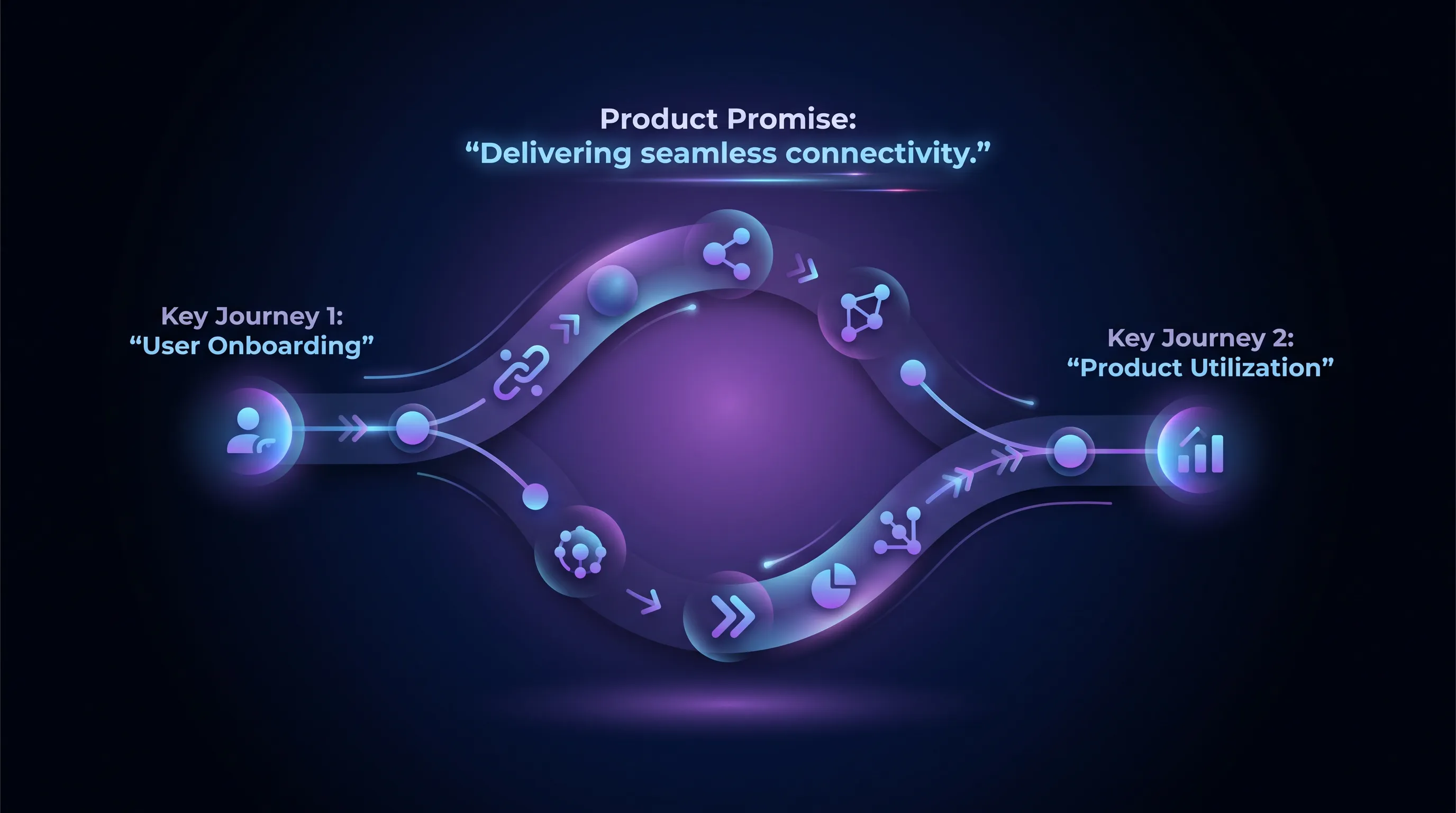
Dark gradient background with soft purple glow, featuring dynamic data points and bold text: "Product Promise: Delivering seamless connectivity," "Key Journe…

Write one short document and make it the spine of every session. The map is the set of things you'd tell a smart new colleague over two hours if you only got two hours.

Cover the product promise in a sentence, the primary users and what each group is trying to get done, and the two or three journeys that carry most of the value. Add your domain language, because the vocabulary your business uses is the vocabulary in the code. Eric Evans called this the ubiquitous language, a vocabulary shared by everyone inside a bounded context, and every translation between business words and technical words is a place where meaning leaks.

Then the parts people forget:

  • Success measures, with the current numbers, so the team knows what "better" looks like

  • Known constraints, whether regulatory, contractual, or inherited from a system you can't replace yet

  • Integrations, with what each one does, who owns the account, and what breaks when it fails (payments, email, analytics, third-party APIs)

  • Current priorities, ranked, and what you're deliberately not doing this quarter

  • Rejected ideas and why they were rejected, which is the single highest-value section in the whole map

That last one saves the most time. Without it, a new team will propose the same clever solution someone before them already tried and abandoned, and you’ll spend a sprint explaining history you could have written down once.

Brief the team

Documents answer the questions you anticipated. The briefing exists so engineers can interrupt and ask the awkward question about why the refund flow has two different states that both say “pending.” The briefing exists so engineers on the dedicated software development team can interrupt and ask the awkward question about why the refund flow has two different states that both say "pending."

Run these sessions in the first two weeks and keep them small enough that people actually talk.

Demonstrate real user workflows

Open the live product and walk the primary journeys end to end. Stay on the critical workflow. The real path includes the step where the customer has to re-enter the address because the form clears, and the workaround you or your support team invented in 2023 that some of your most valuable customers now depend on.

Say out loud what happens to the business when each workflow breaks. The engineers need to know that a failed checkout costs revenue and a failed export costs a renewal before they estimate anything. Friction you've stopped noticing is the most valuable thing you can show.

Hold stakeholder sessions

Give the team direct access to product and support, or to whoever answers customer emails if that’s still you. Let them ask questions without a translator in the middle. Support will tell them things no roadmap document contains, because support hears the same complaint forty times a week.

Record every question that doesn't get answered in the room and assign an owner. Unanswered questions get filled with assumptions, and those assumptions surface three months later as defects. For 30% of developers, knowledge silos hit productivity ten or more times a week. An external team makes silos worse by default, because it has no informal channel to route around them.

Use teach-back sessions

Ask the team to explain your product to you. Users and journeys, in their own words, with the slides closed. You'll find out within ten minutes whether the briefing landed.

The technique comes from clinical practice, where it has a measurable effect. In the Emergency Teach-Back study published in the International Journal of Emergency Medicine, nearly half of patients had incomplete comprehension after standard discharge instructions, compared with one in ten after teach-back, and the conversation added under two minutes. The same asymmetry applies to your product briefing. Correcting a misunderstanding in a conversation costs minutes. Correcting it after it's been built costs a sprint.

Let's Build Something Great

Tell us about your idea. 24-hour response. NDA-friendly.

Book a Discovery Call →

Provision access before work

Nothing kills momentum like an engineer who understands your product and can't run it. Access requests that trickle in over two weeks turn a prepared team into an expensive waiting room.

Grant least-privilege access, which the National Institute of Standards and Technology defines as the minimum necessary to accomplish assigned tasks, and provision it all before day one:

  • Repositories, documentation, and the issue tracker

  • Staging environments and the cloud resources behind them

  • Observability tools, logs, and dashboards, not just the code

  • Communication channels, including the ones where decisions actually get made

  • Delivery pipelines for whatever services the team will touch

Then test every account yourself. Industry median time to first commit sits at two to three weeks, and the bottleneck is almost always environment setup rather than capability. One Adaptavist client cut that window from 80 days to four through provisioning automation. Under time-and-materials pricing, every hour spent waiting on a Jira permission is a line item you paid for and got nothing from. Software development team pricing is quoted per hour, so every hour spent waiting on a Jira permission is a line item you paid for and got nothing from.

Provisioning isn’t a one-off. Review access at the end of week two and again at day 30. Remove anything the team hasn’t used, add what it turned out to need, and check that nobody holds credentials they no longer require. Repeat the review whenever someone joins or leaves the team, and at the end of the engagement.

Explain the delivery system

Now the technical layer. Walk through system boundaries and how data moves between them, plus the conventions the codebase follows even where they're unwritten. Show the exact test and deploy commands, and have someone on the team run them while you watch.

Cover the team’s rituals too: sprint length, planning, standups, demos, code review, release cadence, and who signs off a release. Name every third-party integration and show how to test against it. If you don’t have rituals yet, agree a minimal set now, such as a weekly planning call, a demo at the end of each sprint, and a fixed release day, so both sides know when decisions get made.

Hand over your architecture decision records. Michael Nygard proposed the format in a 2011 post at Cognitect, and Martin Fowler notes that each record should be immutable once accepted and superseded, which gives you a readable history of how the system got here. If you don't keep ADRs, the briefing is a good reason to start.

Be explicit about who decides what. Which calls the team makes alone and which need you. Spell out your escalation path for a production incident at 2 am and your definition of done. The Scrum Guide describes that definition as what creates transparency through a shared understanding of what was actually completed, and when two companies are involved, it’s what prevents them from meaning different things by the word “finished.”

Complete one real ticket

Pick something small and genuinely part of a user journey that matters. A typo fix teaches nothing, and a feature risks too much. Something that touches real code on a path a real customer walks.

Run it through the full cycle:

  1. Pair an external engineer with one of yours for the implementation

  2. Review the code with your normal standards

  3. Agree a rollback plan, then test and deploy the change and watch the dashboards together afterwards

  4. Have the team demo the change and explain the user impact in product terms

Agree the rollback plan before the deploy, not during it: how to revert the change, who makes that call, and how users will be told if needed. Practising it on a small ticket means the first real incident isn’t also the first time anyone has tried it. Pairing costs time and buys quality. In experiments run with University of Utah students in 1999 and written up by Alistair Cockburn and Laurie Williams, pairs spent about 15% more person-hours and produced code with about 15% fewer defects. Students on small tasks are not a product team, so treat the numbers as direction rather than a forecast. On a first ticket, the knowledge transfer matters more than either number. Factor those pairing hours into your budget up front so nobody treats them as overhead to be trimmed.

Keep context current

The failure mode here is predictable. Somebody decides a shared drive can replace the whole thing with 200 documents nobody reads, and three months later everyone agrees that onboarding "didn't work."

Make the new team the maintainers. They read everything with fresh eyes, so they're the only ones who can spot what's missing. Have them update the documents they found wrong and write an ADR for every decision made during the first month. Deloitte surveyed more than 500 executives for its 2024 global outsourcing report and found talent access and agility now rivaling cost as the reason to outsource, which only holds if the knowledge stays after the engagement does.

Measure whether the onboarding worked. Track a handful of numbers from day one: time to first commit, time to first production deployment, how many questions are open and how long they stay open, and how many defects trace back to a misunderstanding rather than a bug. Review them at day 30 and again at day 90. A long time to first commit points to access. Questions that keep coming back point to a gap in the context map.

Done this way, outsourcing stops being a trade-off between cost and continuity. Each onboarding cycle leaves the shared knowledge base stronger than it was, and the software development team pricing you negotiated covers context maintenance.

Where this leaves you

Context transfer is scheduled work with a named owner. It also needs a budget line and a verification step. Skip any of the three, and you'll pay for it later in rework. Run the sequence properly, and the first real deployment arrives in weeks rather than months, with engineers who can argue with your assumptions instead of only executing them.

If you’re preparing to bring external engineers into a product you’ve already started building, we’d be glad to walk through your onboarding plan with you. Reach out to our team for a consultation on structuring and briefing a dedicated software development team.

Let's Build Something Great

Tell us about your idea. 24-hour response. NDA-friendly.

Book a Discovery Call →

Track time to first successful local run, time to first reviewed change, unresolved questions, and teach-back accuracy. Review these measures at day 7, 14, and 30. A rising question backlog or repeated setup failures shows that the onboarding plan needs correction before delivery pressure increases.

Ask each engineer to explain a key user journey, its business value, important constraints, and likely failure points without using the briefing materials. Compare their explanation with the context map. Correct gaps immediately, then repeat the exercise after the first ticket to check whether understanding carried into implementation.

Review temporary access at the end of onboarding and after every change in team responsibilities. Remove permissions that no longer support assigned work, rotate shared credentials, and record approval for access that remains. This keeps the team productive while limiting the damage from an unused or compromised account.

Yes, if the decision falls within agreed authority and follows the project’s review standards. Decisions that affect security, public interfaces, costs, or major system boundaries should go to the named internal owner. Record the reasoning in an architecture decision record so the client can review the choice later.

Book a Discovery Call

Tell us about your idea. 24-hour response. NDA-friendly.

You Might Also Like

Discover more insights and articles